

The ruling clears the way for Haitian TPS to expire. Here is where it hits home care hardest.
A Supreme Court ruling this year cleared the way for Haiti’s Temporary Protected Status to expire, putting the work authorization of thousands of Haitian home care workers at risk. Home Health Care News reported that agencies are already seeing staffing gaps, turned-away referrals, and strained relationships with hospitals and health systems.
The Supreme Court Haiti TPS ruling removes work authorization from a workforce of roughly 330,000 people, more than half of whom live in four metropolitan areas: Miami-Fort Lauderdale-West Palm Beach, New York-Newark-Jersey City, Orlando-Kissimmee-Sanford, and Boston-Cambridge-Newton. Nearly 10% of the active Haitian TPS labor force works in healthcare, concentrated in exactly the direct care roles home care agencies struggle to fill.
Which markets does the Supreme Court Haiti TPS ruling hit hardest?
The impact is not spread evenly. Over half the Haitian TPS population lives in four metro areas, and those same areas carry heavy home care demand.
| Market | Scale | Where it lands |
|---|---|---|
| Florida South Florida, Orlando |
~158,000 TPS holders, roughly 49% of the national total | Broward, Miami-Dade, and Palm Beach counties lead the nation in Haitian population. Nursing homes, assisted living, and home care agencies are most acutely affected. |
| New York NYC metro |
Roughly 19% of the national total, second-largest | Brooklyn is a major hub for the Haitian diaspora. Agencies across the five boroughs are strained in a market where personal care aides were already scarce. |
| Massachusetts Boston, Brockton |
Estimated 22,000 to 45,000 TPS holders statewide | The Massachusetts Senior Care Association reports thousands serving as frontline elder care staff and warns of immediate capacity problems. |
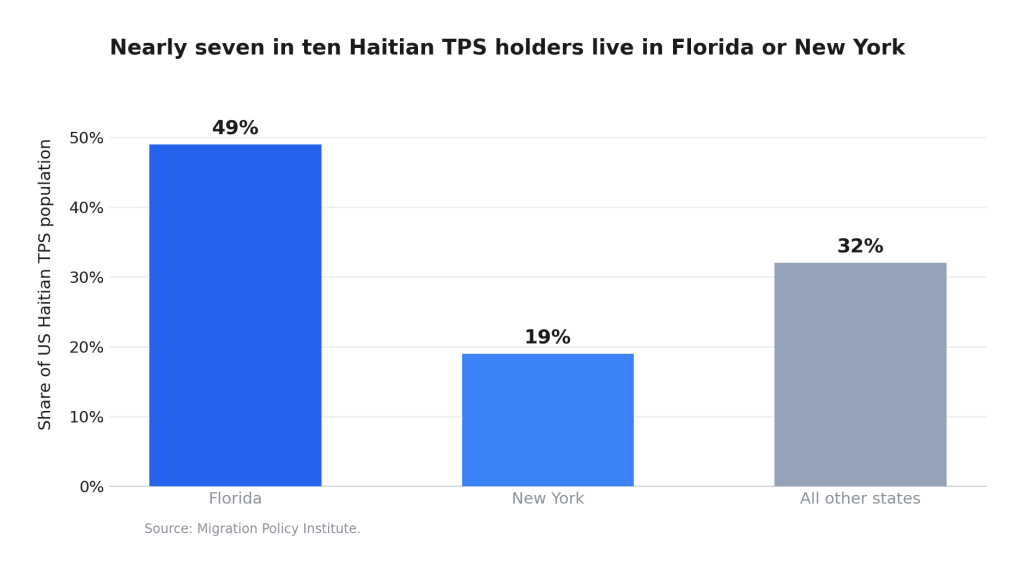
Applied to Florida’s 158,000 TPS holders, that healthcare share points to roughly 15,000 workers in that state alone, concentrated in certified nursing assistant and home health aide roles.
How does a shrinking applicant pool change caregiver recruiting?
The math on speed gets worse, not better, when there are fewer caregivers to hire. Caregivers apply to ten or twenty agencies at once, the first agency to respond usually wins the interview, and the interview usually wins the hire. That dynamic does not change when the pool shrinks. What changes is how much each missed candidate costs you.
Waiting longer than 48 hours means most candidates are already booked elsewhere by the time you reach out. When applicant volume is high, falling off that cliff is a nuisance. When a chunk of the workforce just lost its right to work, it means turning away referrals you cannot afford to lose.
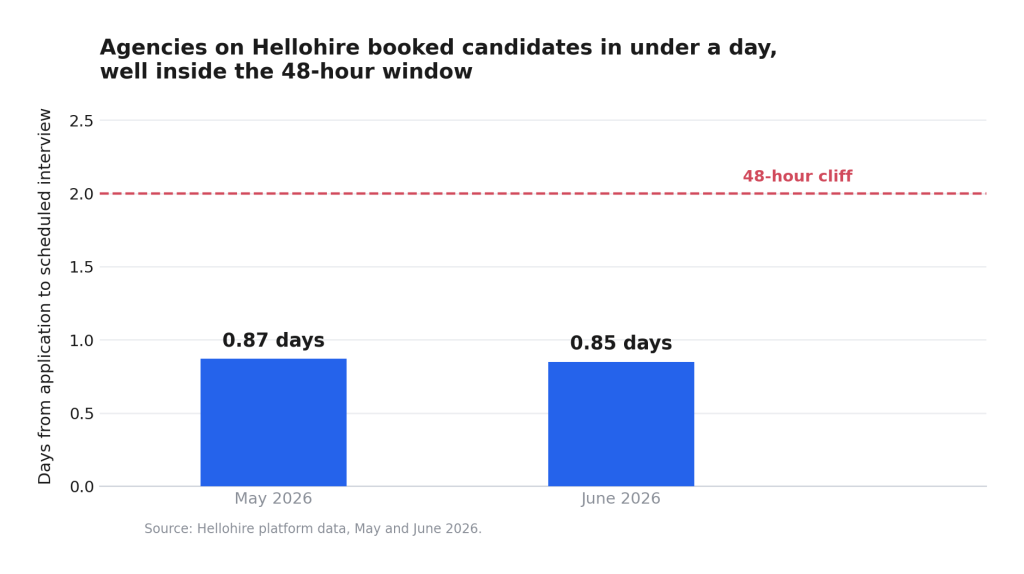
In June 2026, agencies on Hellohire scheduled candidates within an average of 0.85 days of applying, and 0.87 days in May 2026. In June, only 49.3% of applicants reached the interview stage at all, so half the funnel goes to people who were never going to qualify. The speed that used to be a competitive edge is becoming a survival requirement in the affected markets.
The pool is smaller. Act like it.
Policy changes sit outside your control. Your response time does not. Hellohire contacts every applicant by text and email within minutes, screens them against your requirements automatically, and lets qualified candidates book straight onto your team’s real calendar.
More on the mechanics in Caregiver Response Time: Why Speed Beats Application Volume, and the monthly figures in The State of Home Care Hiring: June 2026. To see how fast your team could be responding, book a demo with Hellohire.
Frequently Asked Questions
What did the Supreme Court Haiti TPS ruling actually do?
It cleared the way for Haiti’s Temporary Protected Status to expire, ending work authorization for covered Haitian nationals regardless of tenure or performance.
Which states lose the most home care workers?
Florida holds roughly 49% of the US Haitian TPS population and New York roughly 19%, per the Migration Policy Institute. Massachusetts ranks third.
How many Haitian TPS holders work in healthcare?
Nearly 10% of the active Haitian TPS labor force, according to the Center for Migration Studies. Against 330,000 nationally, that is tens of thousands of direct care workers.
How should agencies respond to the caregiver shortage?
Shorten the time between application and first contact. With fewer candidates available, each missed applicant costs proportionally more.