
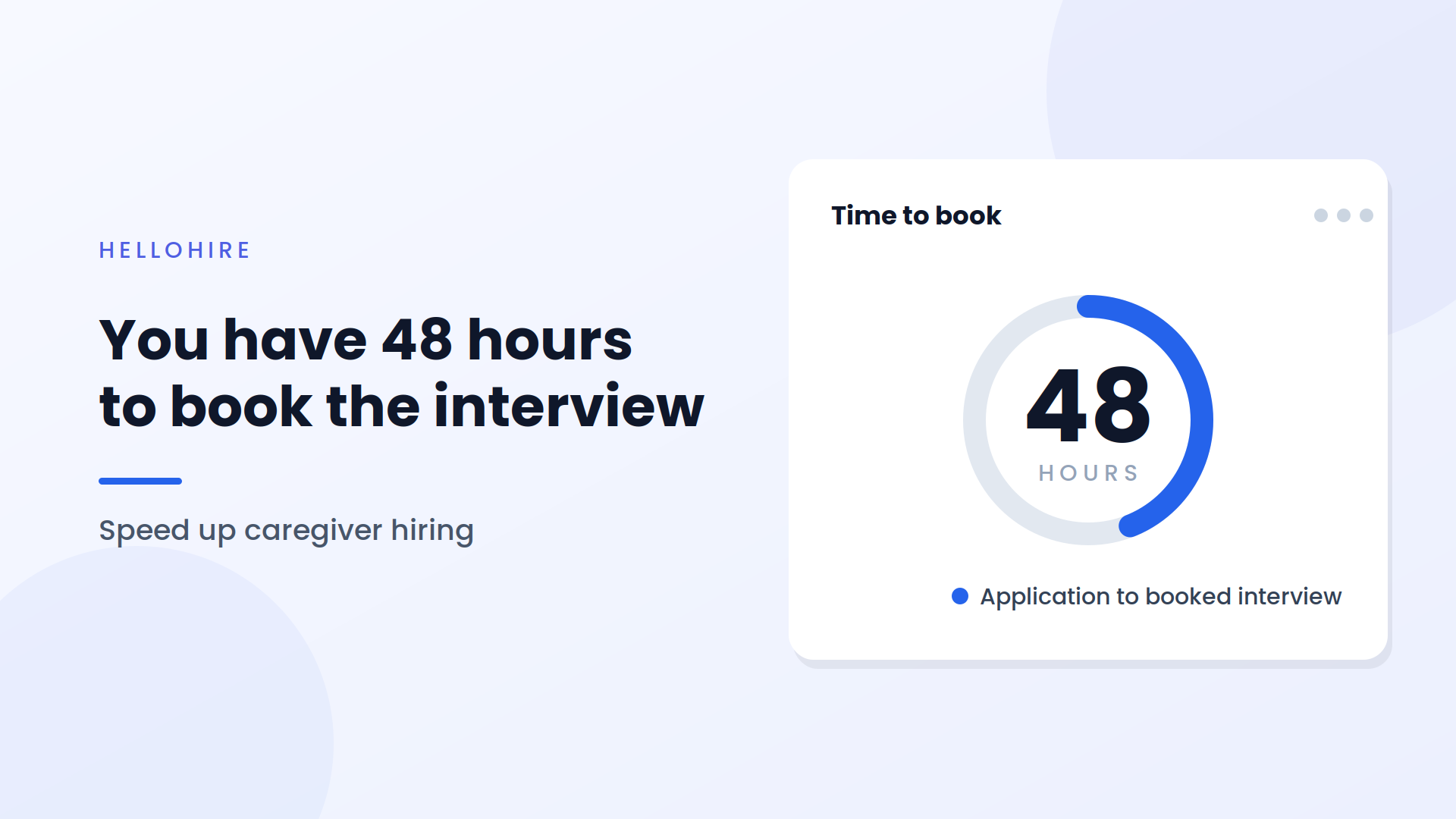
An HR Executive recently highlighted that frontline hiring managers can borrow what corporate recruiting has spent decades refining, including process discipline and how it evaluates for fit, without giving up speed. Home care tests that last condition hardest. A corporate recruiter can spend two weeks moving a candidate from application to offer and still fill the role. The caregiver who applied Monday is interviewing elsewhere by Wednesday afternoon.
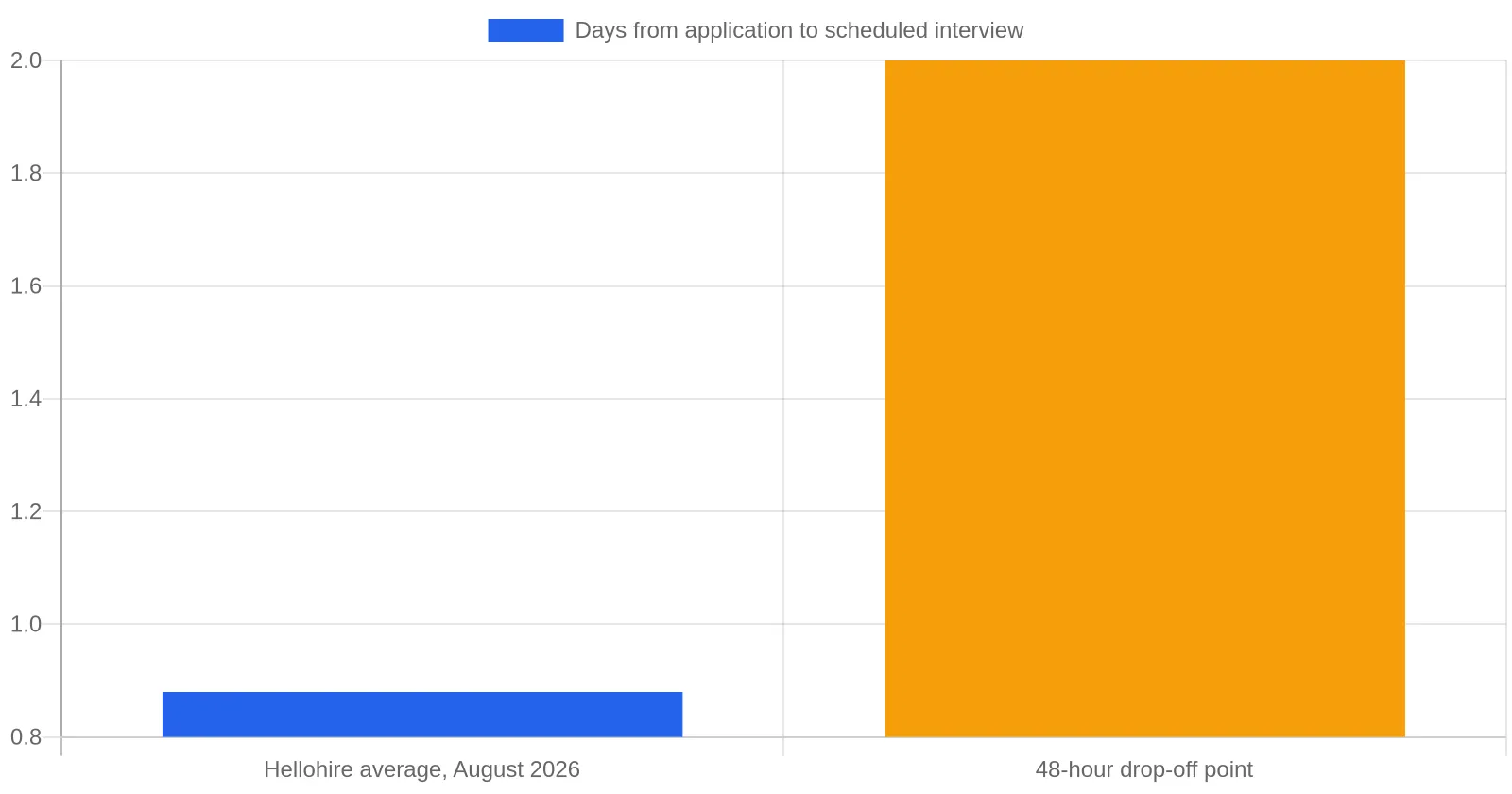
To speed up caregiver hiring, agencies have to compress the corporate playbook into hours rather than weeks. In August 2026, agencies using Hellohire scheduled caregivers an average of 0.88 days after they applied. Caregivers apply to ten or twenty agencies in one sitting, so the one that books the interview first usually gets the hire. Past 48 hours, most of those candidates are already committed somewhere else.
Why caregiver hiring runs on a different clock
Corporate recruiting assumes a candidate pool that waits. A software engineer who applies on Monday is usually still available for a call the following week, since she isn’t filling out nineteen other applications the same afternoon.
A Caregiver, CNA or HHA is doing exactly that, and not out of disloyalty. They need work now. Panel reviews and second rounds booked a week out assume the candidate has somewhere to wait.
| Step | Corporate playbook | Home care reality |
|---|---|---|
| First response | Within a few business days | Within minutes, nights and weekends included |
| Screening | A recruiter reads every resume | Automatic filtering against requirements before anyone looks |
| Scheduling | Email back and forth to find a time | The candidate books their own slot |
| Second round | Booked a week out | The candidate has usually accepted elsewhere |
How fast do you need to respond to a caregiver application?
Under 48 hours, and same day beats that. In August 2026, agencies using Hellohire scheduled candidates an average of 0.88 days after they applied. Past the 48-hour line, whoever reached the caregiver’s calendar first decides the outcome.
The mechanics are in our piece on why a 3.8-day time to hire is still too slow for home care.
What to change to speed up caregiver hiring
Keep the structure and drop the pacing. A consistent screening question set is smart. Waiting three days to ask it isn’t. A caregiver who applies at 9pm Saturday shouldn’t wait until Monday for a reply. If nobody on your team works those hours, something else has to.
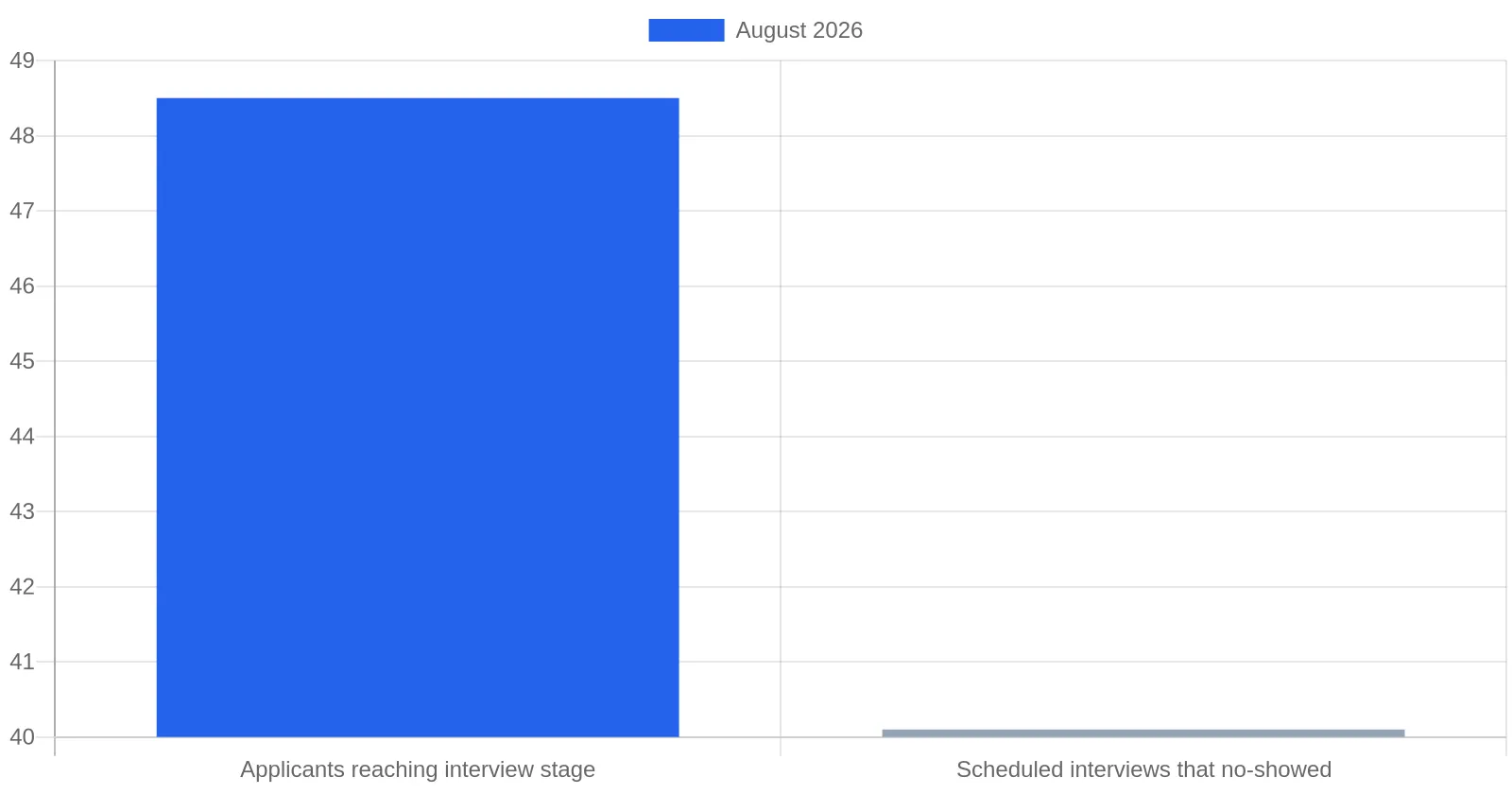
Screen before you schedule instead of after. In August 2026, 48.5% of applicants reached the interview stage, so just over half never got there, the inverse of that figure rather than a separate measurement. Filtering against your requirements before a person gets involved gives those hours back. Then let candidates pick their own slot, since every round of scheduling email lets a faster agency step in. Keep an eye on the 40.1% no-show rate in our August 2026 benchmarks, since a booked interview still has to happen.
Book the interview first
Technology handles what runs on speed and consistency: first response, screening, booking, reminders. Judgment about who fits a family’s care needs stays with your team.
Hellohire contacts every caregiver applicant by text and email within minutes, at any hour, and keeps following up until they respond. It screens against your requirements automatically, then lets qualified candidates book straight onto your real calendar, with interviews running on built-in video. For teams without the bandwidth to run interviews daily, our Managed Recruiting Service puts our recruiters on those live video calls, at a fraction of what a full-time in-house recruiter costs.
Speed is also the hiring metric that predicts census before it drops. Book a demo with Hellohire to see where your agency lands.
Frequently asked questions
How fast should you respond to a caregiver application?
Inside 48 hours, and same day is better. Agencies on Hellohire averaged 0.88 days from application to scheduled interview in August 2026.
Why doesn’t corporate recruiting advice work for caregiver hiring?
It assumes candidates wait. Caregivers apply to ten or twenty agencies at once and usually take whichever interview gets offered first.
What share of caregiver applicants reach an interview?
48.5% in August 2026. The rest either fall short of the agency’s requirements or lose interest before anyone reaches them.
Do faster interviews still get no-shows?
Yes. 40.1% of scheduled interviews ended in a no-show in August 2026, so reminders and easy rescheduling still earn their place.
Sources: HR Executive, “What frontline hiring managers can learn from corporate recruiting,” by Danny Rojas, September 11, 2026 (the case that frontline hiring can borrow corporate recruiting’s discipline without giving up speed). Hellohire figures for August 2026 reflect anonymized platform data, covering time from application to scheduled interview, application to interview rate, and interview no-show rate. The step-by-step comparison above is Hellohire’s own framing.